
You ran a sweep and picked the best candidate. Was that a real edge, or the luckiest parameter on this slice of history? A sweep selects and scores on the same data, so its winner is in-sample evidence. It cannot tell you whether the rule generalizes.
Walk-forward evaluation answers the generalization question. It splits time into folds, and in each one it selects a candidate on a train window, then tests only that candidate on the next, untouched window. The test window is held-out evidence: the selection never saw it.
for each fold:
  train snapshot window -> sweep candidates -> scalar selection
  selected candidate -> test window run -> recorded evidence
Walk-forward uses the same ledgr_sweep() and ledgr_run() machinery as the rest of ledgr; it does not add a separate execution engine. By the end of this article you will run a multi-fold evaluation, read its train-versus-test degradation table, and extract a candidate for review.
Setup
Running this yourself
The code writes to a temporary DuckDB store, so the article leaves no project files behind. The demo-data window and fold sizes are kept small so the vignette runs quickly; they are not a statistical recommendation.
The experiment is the same kind of object used by ledgr_run() and ledgr_sweep().
features <- ledgr_feature_map(
  fast = ledgr_ind_sma(ledgr_param("fast_n")),
  slow = ledgr_ind_sma(ledgr_param("slow_n"))
)

exp <- ledgr_experiment(
  snapshot = snapshot,
  strategy = ledgr_demo_sma_crossover_strategy(),
  features = features,
  opening = ledgr_opening(cash = 10000),
  cost_model = ledgr_cost_zero()
)
Folds And The Train/Test Boundary
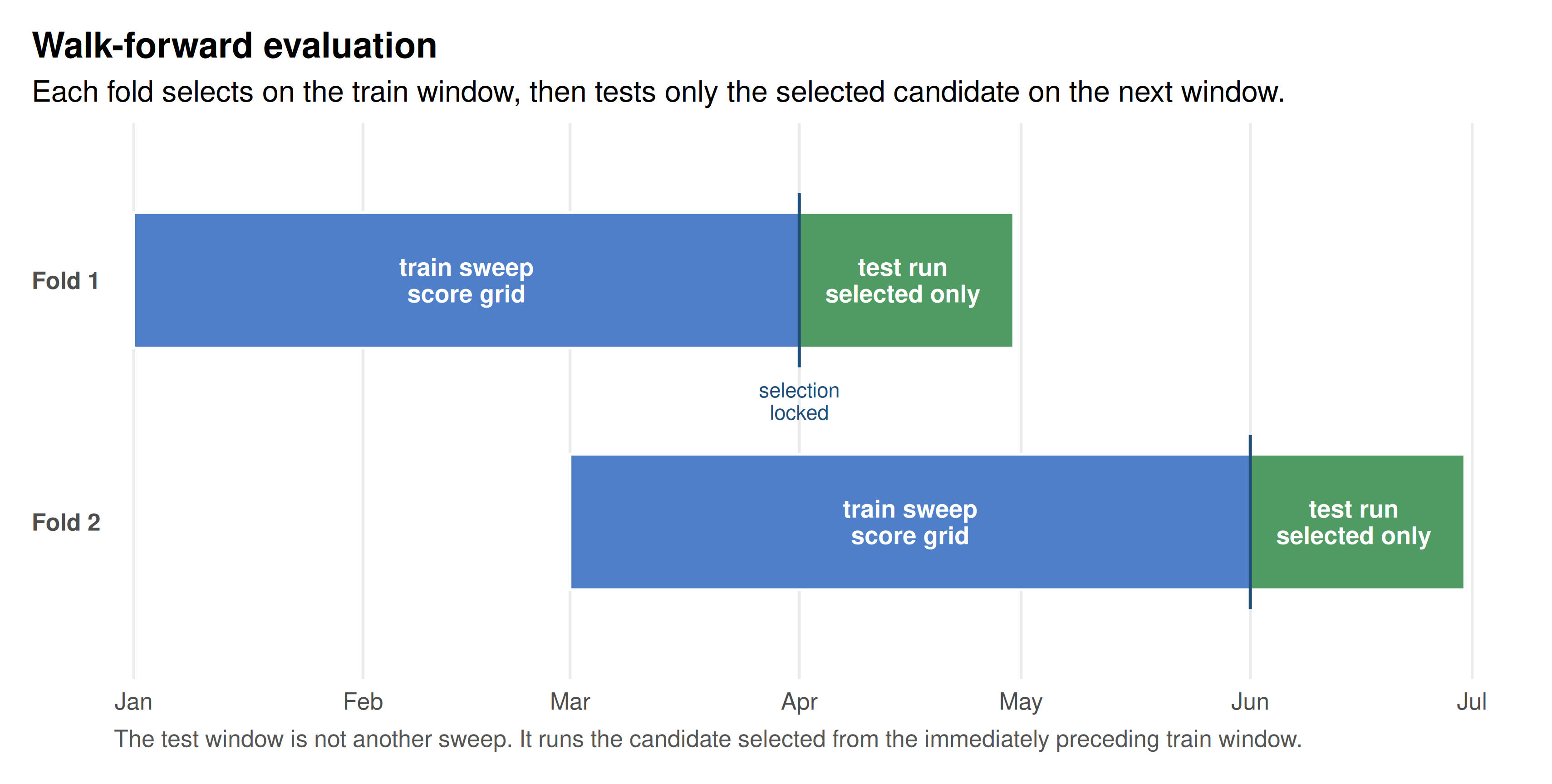
Folds are calendar-time value objects. They describe train and test scoring windows; they do not execute anything by themselves.
folds <- ledgr_folds_rolling(
  start = "2019-01-01",
  end = "2019-07-31",
  train_window = "3 months",
  test_window = "1 month",
  step = "2 months"
)

folds
#> ledgr fold list
#> ================
#> Scheme: rolling
#> Folds:  2
#> Hash:   12a94353eb09
#>
#> # A tibble: 2 x 3
#>    fold train                    test
#>   <int> <chr>                    <chr>
#> 1     1 2019-01-01 -> 2019-03-31 2019-04-01 -> 2019-04-30
#> 2     2 2019-03-01 -> 2019-05-31 2019-06-01 -> 2019-06-30
Plotting the folds makes the core contract easier to see. The blue train window sweeps and scores the grid. At the boundary, ledgr locks one selected candidate. The green test window then runs only that candidate.
Build The Grid And Run It
Build a small grid. Feature parameters vary the concrete SMA windows. Strategy parameters vary the target quantity and threshold.
feature_grid <- ledgr_feature_grid(
  fast_n = c(5L, 10L),
  slow_n = 20L,
  .filter = fast_n < slow_n
)

strategy_grid <- ledgr_strategy_grid(
  qty = 5,
  threshold = 0
)

grid <- ledgr_grid_cross(features = feature_grid, strategy = strategy_grid)
The selection rule is explicit and scalar: ledgr selects one candidate per fold from the train-window score rows.
wf <- ledgr_walk_forward(
  exp,
  grid = grid,
  folds = folds,
  selection_rule = ledgr_select_argmax("sharpe_ratio"),
  seed = 2026L
)
#> Warning: no DISPLAY variable so Tk is not available

wf
#> ledgr walk-forward
#> ==================
#> Health warning: one or more test windows are shorter than 90 calendar days.
#>
#> Train/test degradation:
#> # A tibble: 2 x 7
#>   fold_seq selection_metric train_metric_value test_metric_value metric_diff_abs
#>      <int> <chr>                         <dbl>             <dbl>           <dbl>
#> 1        1 sharpe_ratio                   1.98             0.800           -1.18
#> 2        2 sharpe_ratio                   2.08             3.64             1.56
#> # i 2 more variables: warning_flags <chr>, selected_candidate <chr>
#>
#> Session: b0366de684834ad4749de056d1a49a07a6e73d0910f430c0d020f4321ae00563
#> Status: DONE
#> Opening state: carry_test_state
#> Folds: 2
Read The Degradation Table First
The degradation table is the first surface to inspect. Printing it shows the core train-versus-test columns; the full table, including the window ranges and percentage change, is one as_tibble() away.
wf$degradation
#> # ledgr walk-forward degradation
#> # A tibble: 2 x 7
#>   fold_seq selection_metric train_metric_value test_metric_value metric_diff_abs
#>      <int> <chr>                         <dbl>             <dbl>           <dbl>
#> 1        1 sharpe_ratio                   1.98             0.800           -1.18
#> 2        2 sharpe_ratio                   2.08             3.64             1.56
#> # i 2 more variables: warning_flags <chr>, selected_candidate <chr>
#>
#> # i Hidden columns: train_window, test_window, metric_diff_pct. Use as_tibble() for the full table.
metric_diff_abs is test_metric_value - train_metric_value. Whether a positive value means improvement or degradation depends on the selection rule direction.
Short test windows may carry warning flags. Those warnings are not failures; they are metadata telling you how to interpret the evidence.
Extract A Candidate With A Rationale
Use ledgr_candidate() to extract the selected candidate for a specific fold. Using "latest" is allowed only with a rationale.
candidate <- ledgr_candidate(
  wf,
  fold_seq = "latest",
  selection_rationale = "Documentation example: inspect the latest completed fold."
)

candidate$candidate_id
#> [1] "feature_af0f94c90243/strategy_86be010cf688"
Promotion uses the same candidate object as sweep promotion. In a real research project, promote only after you have written down why this fold and candidate are being reviewed.
promoted <- ledgr_promote(
  exp,
  candidate,
  run_id = "wf_latest_review",
  note = "Manual review accepted the latest completed fold."
)
Reading The Evidence Honestly
A degradation table is easy to over-read. Three things bound what it can tell you.
Walk-forward evidence is only as survivorship-safe as the sealed snapshot and universe semantics it evaluates.
Selection integrity is a separate question
Reproducibility and selection integrity are orthogonal. Walk-forward records what was selected and tested; it does not prove that the search space, metric, or selection procedure was statistically sound. Scalar scores are not PBO, CSCV, CPCV, DSR, benchmark diagnostics, or a multiple-testing correction. ledgr ships PBO/CSCV, MinTRL, K-Ratio, DSR, and effective-trial diagnostics as separate evidence surfaces; see vignette("selection-integrity", package = "ledgr"). For what provenance does and does not prove, see vignette("reproducibility", package = "ledgr").
Test folds are not independent
The default opening_state_policy = "carry_test_state" is path-dependent. Each completed selected test run may seed the next test opening state, so per-fold test metrics are not independent observations. The explicit opening_state_policy = "flat_test_state" opt-in starts every test window from the original experiment opening state and marks the result as cold_start_distorted.
Anchored folds grow their train window over time. That is useful for some research workflows, but later folds can cost more to compute than early folds, especially with large candidate grids and wide feature sets.
Try It
Try it
Re-run ledgr_walk_forward() with opening_state_policy = "flat_test_state". How does the degradation table change, and why does cold_start_distorted appear? Then widen the test_window in ledgr_folds_rolling() to "2 months" and re-run. Do the short-test-window warning flags go away?
What This Does Not Do
Outside this surface
ledgr does not yet implement paper/live walk-forward, OMS behavior, cross-snapshot walk-forward, benchmark-relative metrics, gross-vs-net attribution, signal decay, implementation/cost decay, or per-fold selection-integrity diagnostics. Those require later surfaces over the stable session and candidate identity introduced here.
Where Next
- For the sweep and selection mechanics this builds on, see
vignette("sweeps", package = "ledgr"). - For the full research arc from idea to reviewed candidate, see
vignette("research-workflow", package = "ledgr"). - For hashes, source capture, and the limits of provenance, see
vignette("reproducibility", package = "ledgr"). - For the Sharpe ratio and annualization conventions behind these scores, see
vignette("metric-contexts-and-conventions", package = "ledgr").