| DGP ID | synth_placebo_tau0 |
| Version | 1.3.0 |
| Status | experimental |
| Difficulty | ★☆☆☆☆ (1/5) |
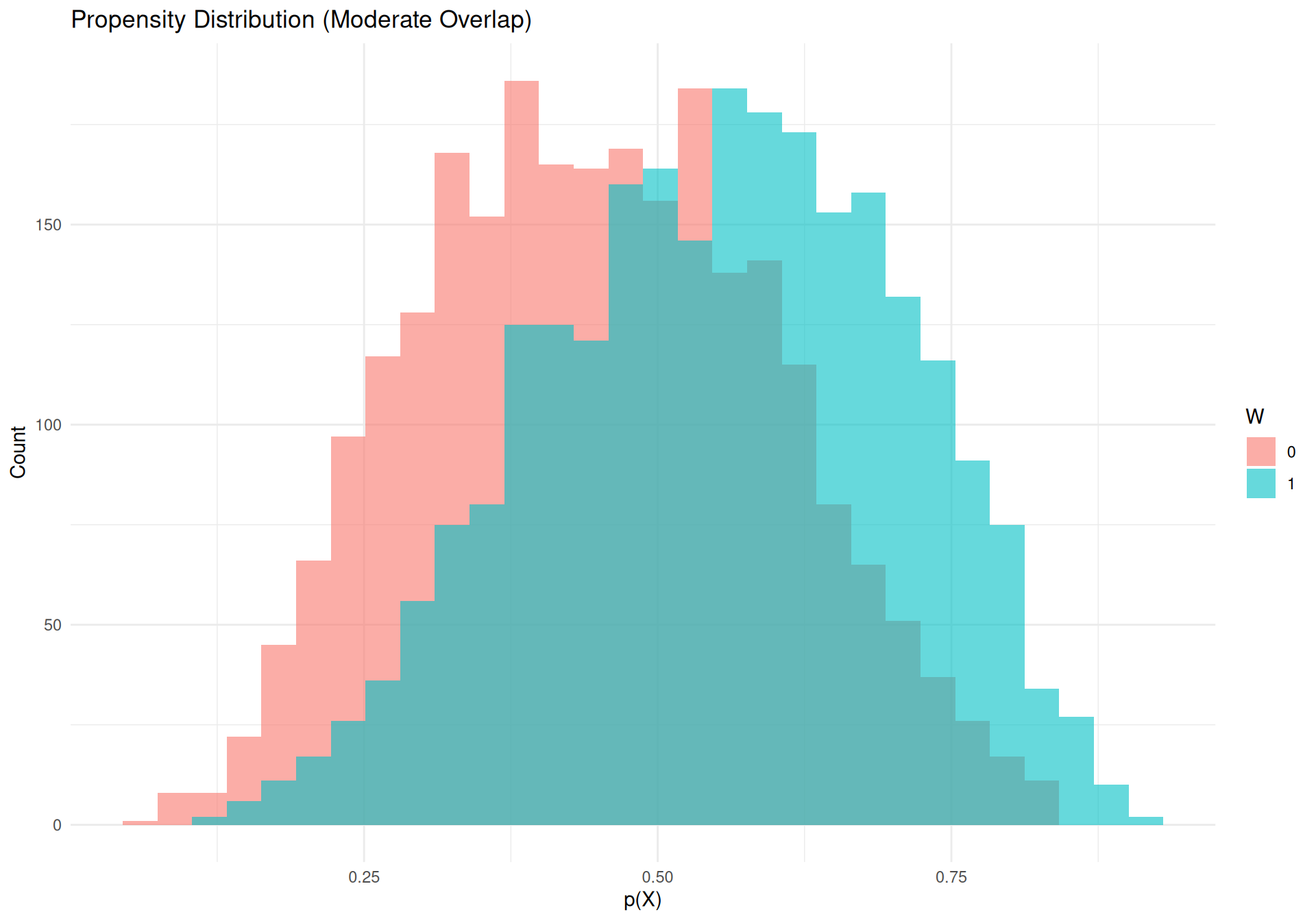
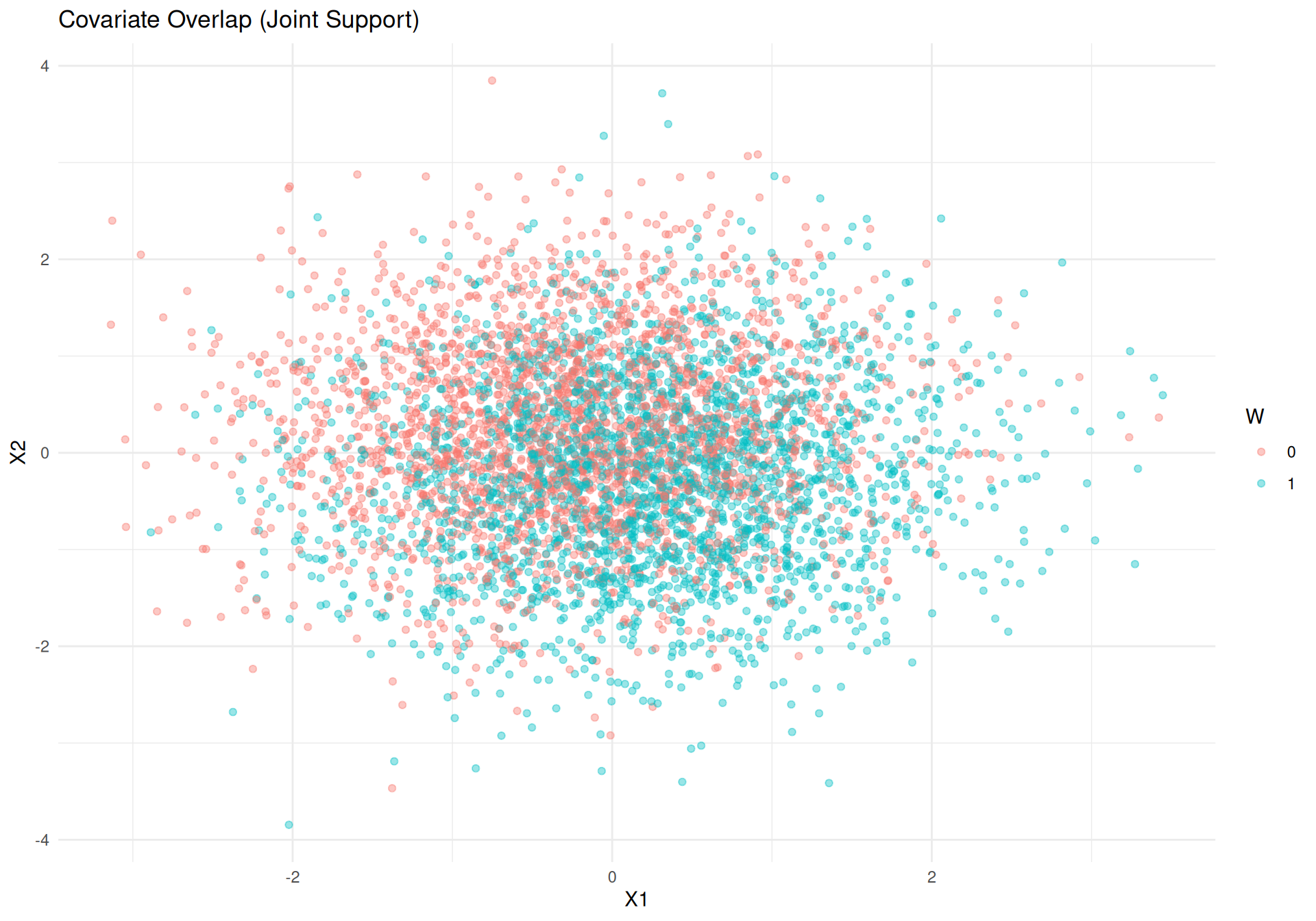
| Stress Profile | overlap: moderatenoise: gaussianlinearity: lineareffect: constanttarget: both |
Intent: The “Calibration Check.” This is the baseline placebo design. It generates data under ideal conditions: linear confounding, Gaussian noise, and a sharp null effect (\(\tau(X) \equiv 0\)).
The Scientific Question: “Does the estimator respect the Null Hypothesis under ideal conditions?” Any estimator that fails here suffers from fundamental coding errors, extreme bias, or improper tuning. It serves as the control group for the stress suite.
Covariates: \(X_1, X_2, X_3, X_4, X_5 \sim \mathcal{N}(0, 1^2)\) independently.
Outcome (control): \[\mu_0(X) = 1 + X_1 + 0.5 X_2\]
Propensity: \[p(X) = \text{expit}(0.5 X_1 - 0.5 X_2)\]
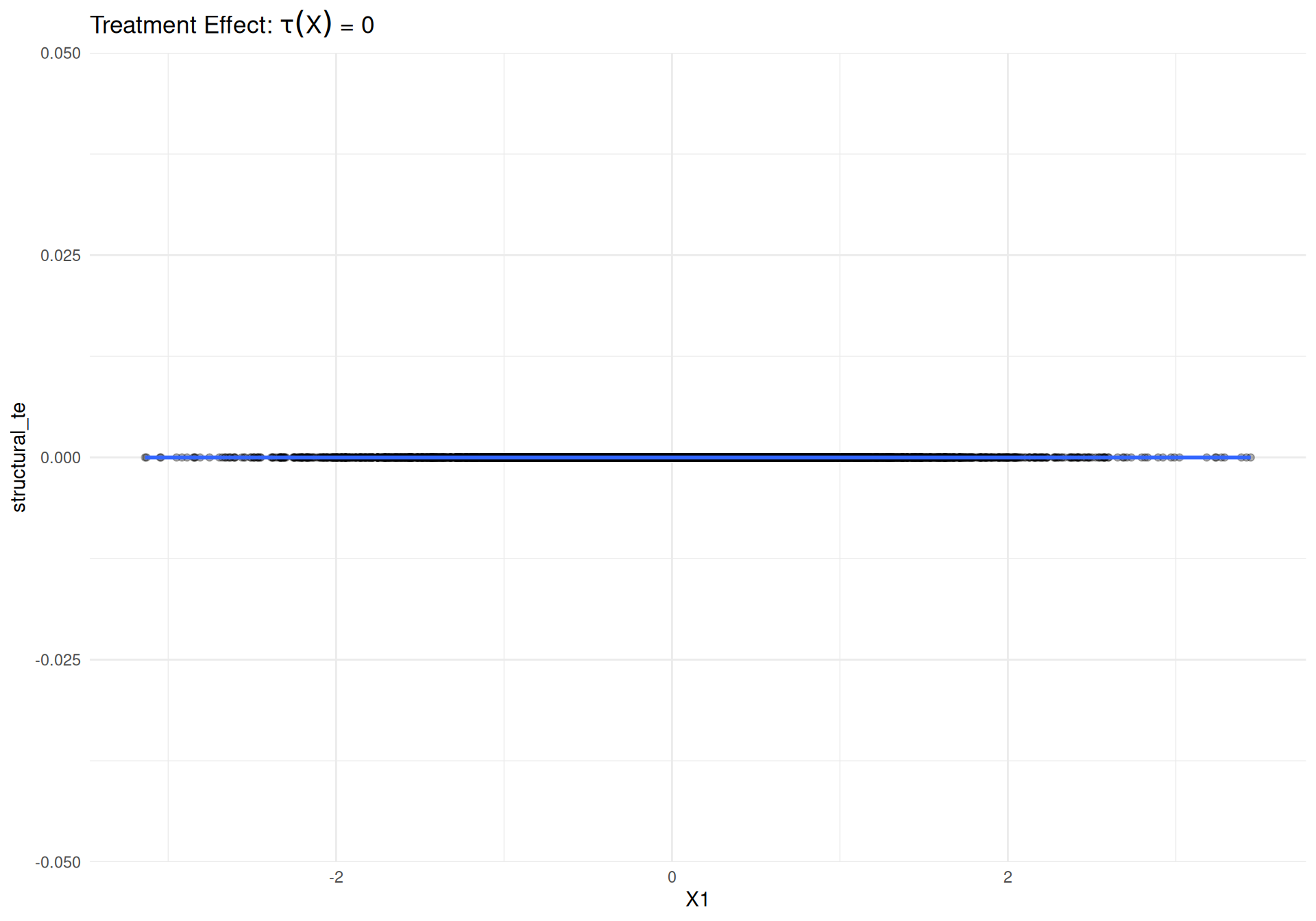
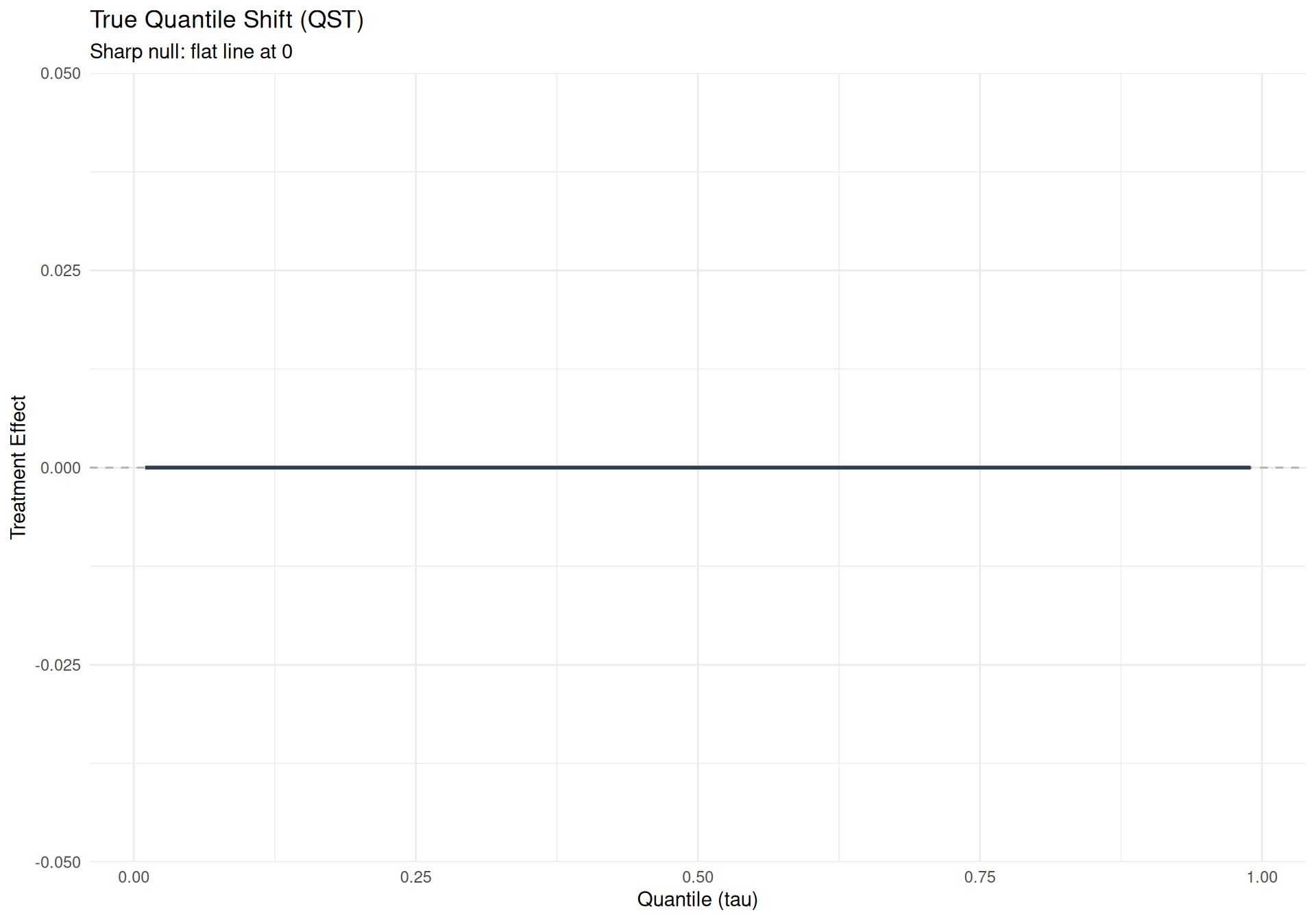
Treatment effect (sharp null): \[\tau(X) \equiv 0\]
Noise is Gaussian: \(\varepsilon \sim \mathcal{N}(0, 0.5^2)\) and \(Y_1 \equiv Y_0\) pathwise.
We validate only the oracle estimator to keep builds fast.
| mean_bias | rmse |
|---|---|
| 0 | 0 |
R/dgp-synth-placebo-tau0.R (v1.3.0)cs_dgp_registry() entry for synth_placebo_tau0true_att = 0, true_qst = 0Source code for: dgp_synth_placebo_tau0_v130
function (n, seed = NULL, include_truth = TRUE, oracle_only = FALSE)
{
if (!is.null(seed)) {
cs_set_rng(seed)
}
X1 <- stats::rnorm(n, mean = 0, sd = 1)
X2 <- stats::rnorm(n, mean = 0, sd = 1)
X3 <- stats::rnorm(n, mean = 0, sd = 1)
X4 <- stats::rnorm(n, mean = 0, sd = 1)
X5 <- stats::rnorm(n, mean = 0, sd = 1)
mu0 <- 1 + X1 + 0.5 * X2
tau <- rep(0, n)
p <- stats::plogis(0.5 * X1 - 0.5 * X2)
w <- stats::rbinom(n, size = 1, prob = p)
eps <- stats::rnorm(n, mean = 0, sd = 0.5)
y0 <- mu0 + eps
y1 <- y0
if (isTRUE(oracle_only)) {
return(list(df = tibble::tibble(w = w, y0 = y0, y1 = y1)))
}
y <- ifelse(w == 1L, y1, y0)
true_att <- cs_true_att(structural_te = tau, w = w)
true_qst <- if (isTRUE(include_truth))
cs_get_oracle_qst("synth_placebo_tau0", version = "1.3.0")
else NULL
out <- list(df = tibble::tibble(y = y, w = w, y0 = y0, y1 = y1,
p = p, structural_te = tau, X1 = X1, X2 = X2, X3 = X3,
X4 = X4, X5 = X5), true_att = true_att, true_qst = true_qst,
meta = list(dgp_id = "synth_placebo_tau0", version = "1.3.0",
type = "synthetic", params = list(n = n, seed = seed),
structural_te = tau))
cs_check_dgp_synthetic(out)
out
}
<bytecode: 0x5611dd6e2980>
<environment: namespace:CausalStress>