| DGP ID | synth_heavytail |
| Version | 1.6.0 |
| Status | stable |
| Difficulty | ★★★☆☆ (3/5) |
| Stress Profile | overlap: moderatenoise: heavylinearity: lineareffect: lineartarget: both |
Purpose: Penalize estimators that rely on L2 loss under heavy-tailed noise.
This DGP is identical to the baseline linear design except for the outcome noise, which is a Gaussian/Cauchy mixture. The Cauchy component makes the population mean of observed outcomes undefined. Consequently, a conventional superpopulation mean potential-outcome ATT does not exist, and estimators that rely on L2 loss or outcome means do not converge to such an estimand.
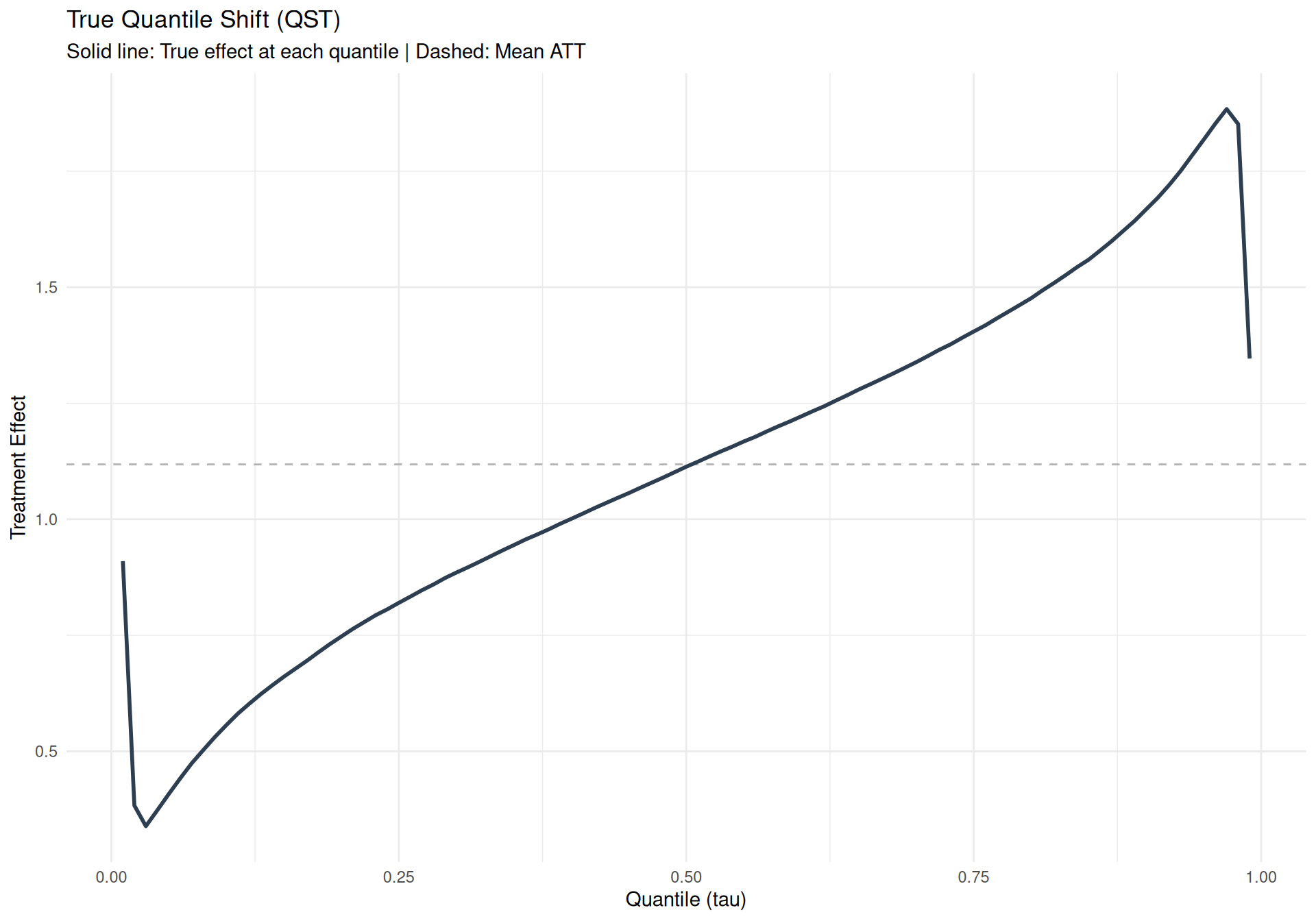
CausalStress deliberately keeps running ATT estimators because their breakdown is the evidence this boundary DGP is designed to produce. The package’s true_att is a governed finite-sample structural signal anchor, not a conventional superpopulation mean potential-outcome ATT. It must not be used for an ATT estimator shootout. QST is the well-defined distributional comparison target in this regime.
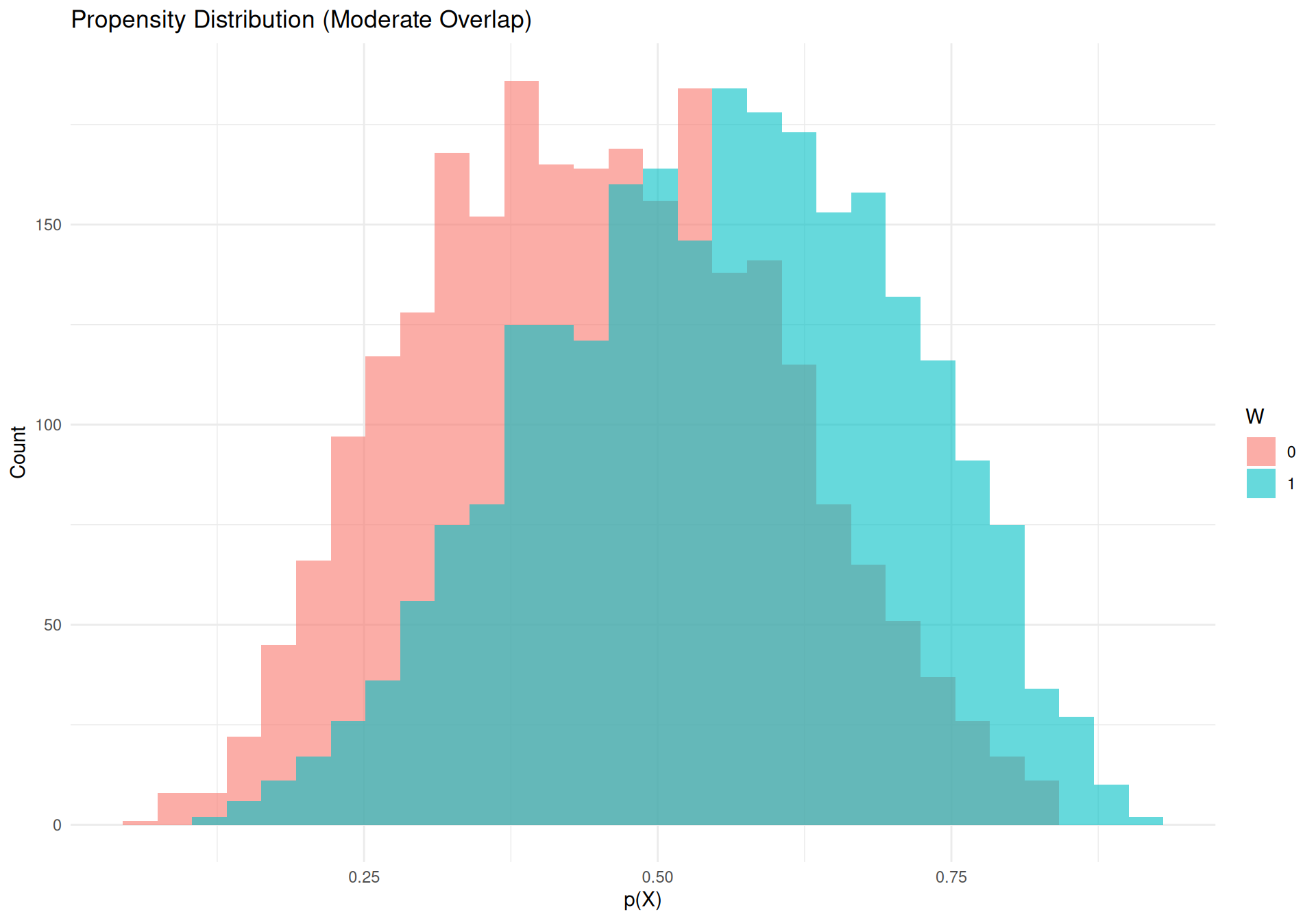
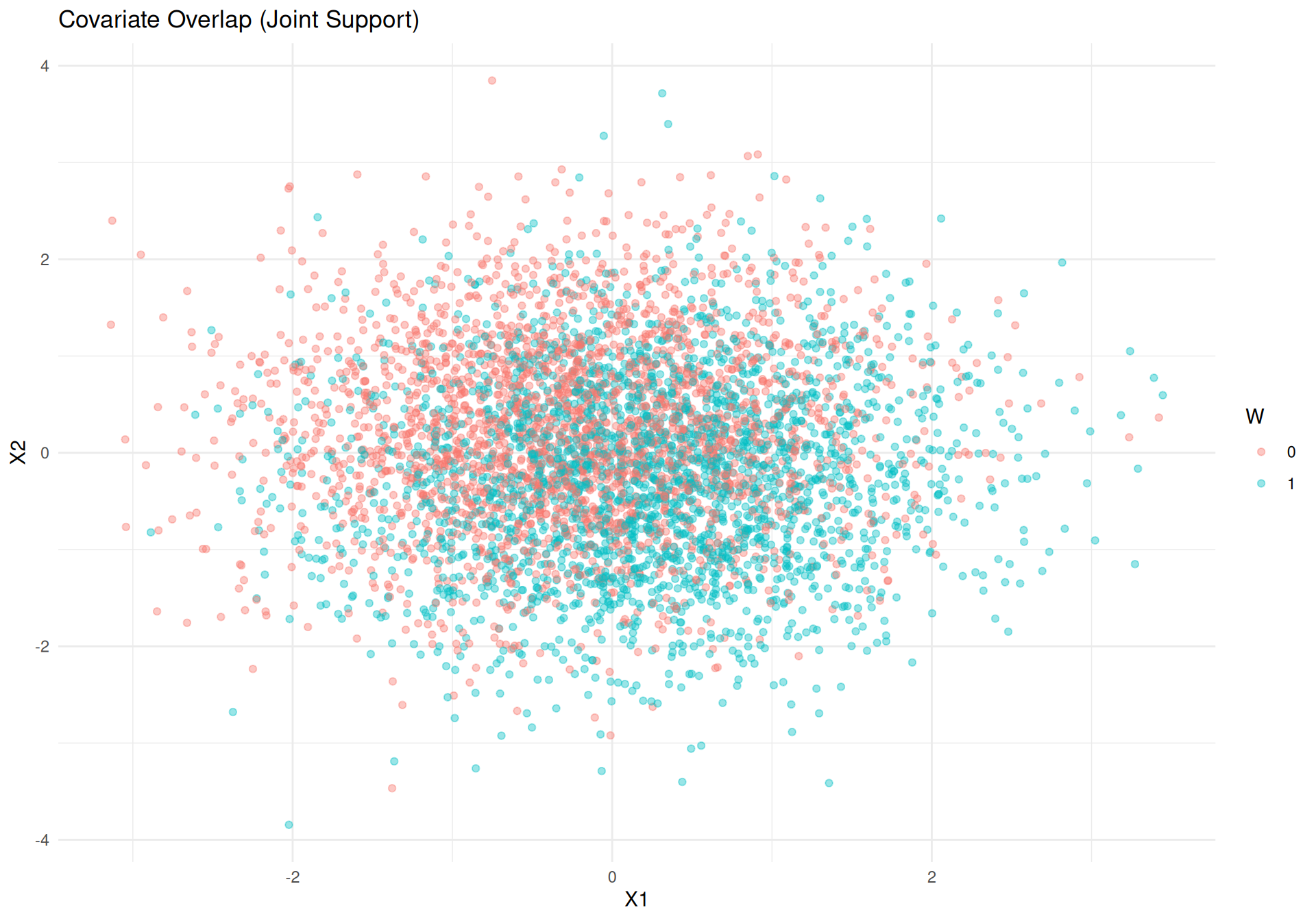
p(X) bounded away from 0 and 1 for most of the mass).tau(X_i) over the run’s treated units (Constitution Article I), independent of realized noise. Because the population outcome means do not exist, this is not a conventional superpopulation mean potential-outcome ATT.Covariates [ X (0, I_5) ]
Propensity [ p(X) = (0.5 X_1 - 0.5 X_2) ]
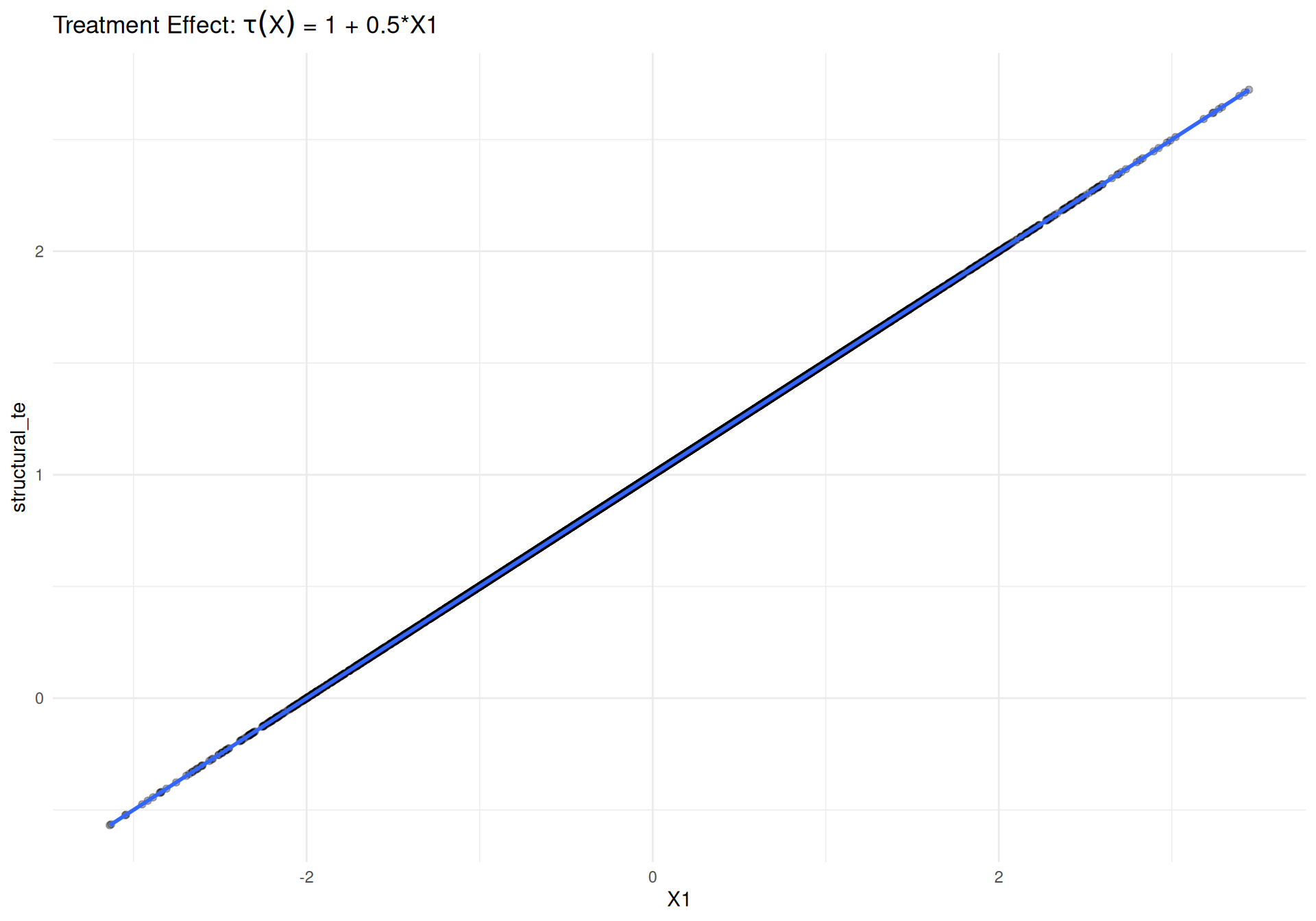
Baseline Outcome and Treatment Effect [ _0(X) = 1 + X_1 + 0.5 X_2 ] [ (X) = 1 + 0.5 X_1 ]
Noise Mixture (Heavy Tails) [ 0.8 (0, 0.5^2) + 0.2 (0, 1) ] where (_0) and (_1) are drawn independently.
Moment note: The Cauchy component has undefined mean and variance. Therefore the population mean of realized outcomes is undefined, and any L2/MSE estimator is not well-posed in the population.
Potential Outcomes [ Y_0 = _0(X) + _0, Y_1 = _0(X) + (X) + _1 ]
true_att): (N_{treated}^{-1}_{i:W_i=1}(X_i)), computed from the deterministic signal ((X)). This governed diagnostic anchor is finite even though the conventional superpopulation mean potential-outcome ATT is not.cs_get_oracle_qst().
We run light validation with n = 1000 and seeds = 1:20. The goal is to show extreme sensitivity of OLS under L2 loss, not to rank ATT estimators. We report finite-replicate diagnostics relative to the structural signal anchor, centered on medians and a quantile; the sample maximum is descriptive only. These are not conventional ATT bias or RMSE. We do not run heavier robust estimators here to keep doc builds fast.
| estimator_id | n_runs | median_anchor_deviation | median_abs_anchor_deviation | p90_abs_anchor_deviation | max_abs_anchor_deviation |
|---|---|---|---|---|---|
| lm_att | 20 | 0.343 | 0.354 | 10.699 | 38.555 |
| oracle_att | 20 | 0.000 | 0.000 | 0.000 | 0.000 |
Interpretation: OLS exhibits non-convergence and extreme seed sensitivity under the Cauchy mixture. Mean bias, RMSE, conventional coverage, and winner rankings are not defined here. The structural oracle reproduces the governed signal anchor; this confirms scorer consistency, not existence of a conventional mean ATT.
true_att: a governed finite-sample signal anchor for diagnostics, not a conventional superpopulation mean potential-outcome ATT in this no-mean regime.R/dgp-synth-heavytail.Rcs_get_oracle_qst("synth_heavytail", version = "1.6.0")inst/dgp_meta/synth_heavytail.ymlSource code for: dgp_synth_heavytail_v160
function (n, seed = NULL, include_truth = TRUE, oracle_only = FALSE)
{
if (!is.null(seed)) {
cs_set_rng(seed)
}
X1 <- stats::rnorm(n, mean = 0, sd = 1)
X2 <- stats::rnorm(n, mean = 0, sd = 1)
if (!isTRUE(oracle_only)) {
X3 <- stats::rnorm(n, mean = 0, sd = 1)
X4 <- stats::rnorm(n, mean = 0, sd = 1)
X5 <- stats::rnorm(n, mean = 0, sd = 1)
}
mu0 <- 1 + X1 + 0.5 * X2
tau <- 1 + 0.5 * X1
p <- stats::plogis(0.5 * X1 - 0.5 * X2)
w <- stats::rbinom(n, size = 1, prob = p)
mix_ind0 <- stats::rbinom(n, size = 1, prob = 0.8)
eps0 <- ifelse(mix_ind0 == 1L, stats::rnorm(n, mean = 0,
sd = 0.5), stats::rcauchy(n, location = 0, scale = 1))
if (isTRUE(oracle_only)) {
eps1 <- eps0
}
else {
mix_ind1 <- stats::rbinom(n, size = 1, prob = 0.8)
eps1 <- ifelse(mix_ind1 == 1L, stats::rnorm(n, mean = 0,
sd = 0.5), stats::rcauchy(n, location = 0, scale = 1))
}
y0 <- mu0 + eps0
y1 <- mu0 + tau + eps1
if (isTRUE(oracle_only)) {
return(list(df = tibble::tibble(w = w, y0 = y0, y1 = y1)))
}
y <- ifelse(w == 1L, y1, y0)
true_att <- cs_true_att(structural_te = tau, w = w)
true_qst <- if (isTRUE(include_truth))
cs_get_oracle_qst("synth_heavytail", version = "1.6.0")
else NULL
out <- list(df = tibble::tibble(y = y, w = w, y0 = y0, y1 = y1,
p = p, structural_te = tau, X1 = X1, X2 = X2, X3 = X3,
X4 = X4, X5 = X5), true_att = true_att, true_qst = true_qst,
meta = list(dgp_id = "synth_heavytail", version = "1.6.0",
type = "synthetic", params = list(n = n, seed = seed),
structural_te = tau))
cs_check_dgp_synthetic(out)
out
}
<bytecode: 0x55aaf61f6638>
<environment: namespace:CausalStress>