| DGP ID | synth_hd_sparse_plm |
| Version | 1.5.0 |
| Status | experimental |
| Difficulty | ★★★★☆ (4/5) |
| Stress Profile | overlap: moderatenoise: gaussianlinearity: lineareffect: constanttarget: both |
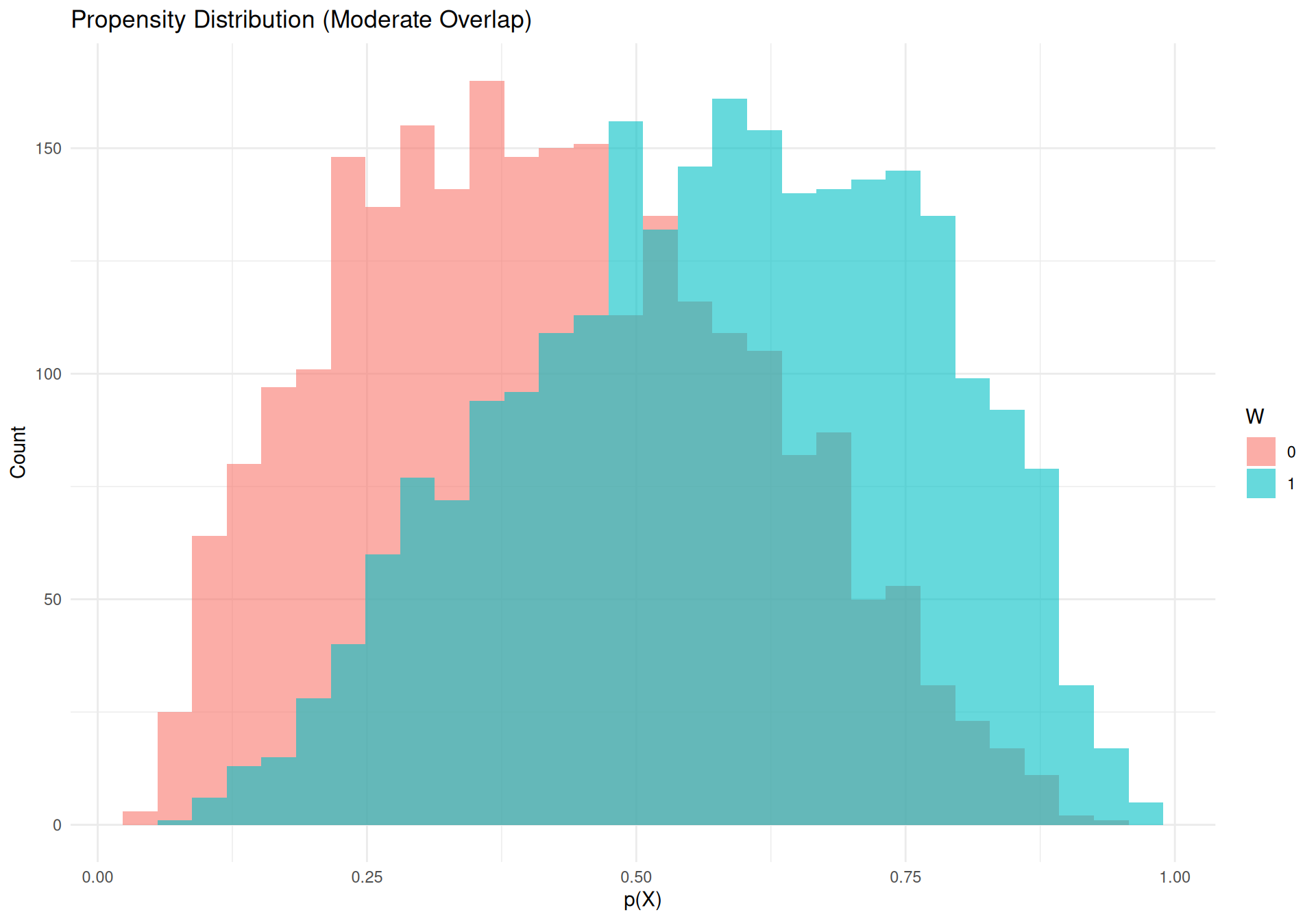
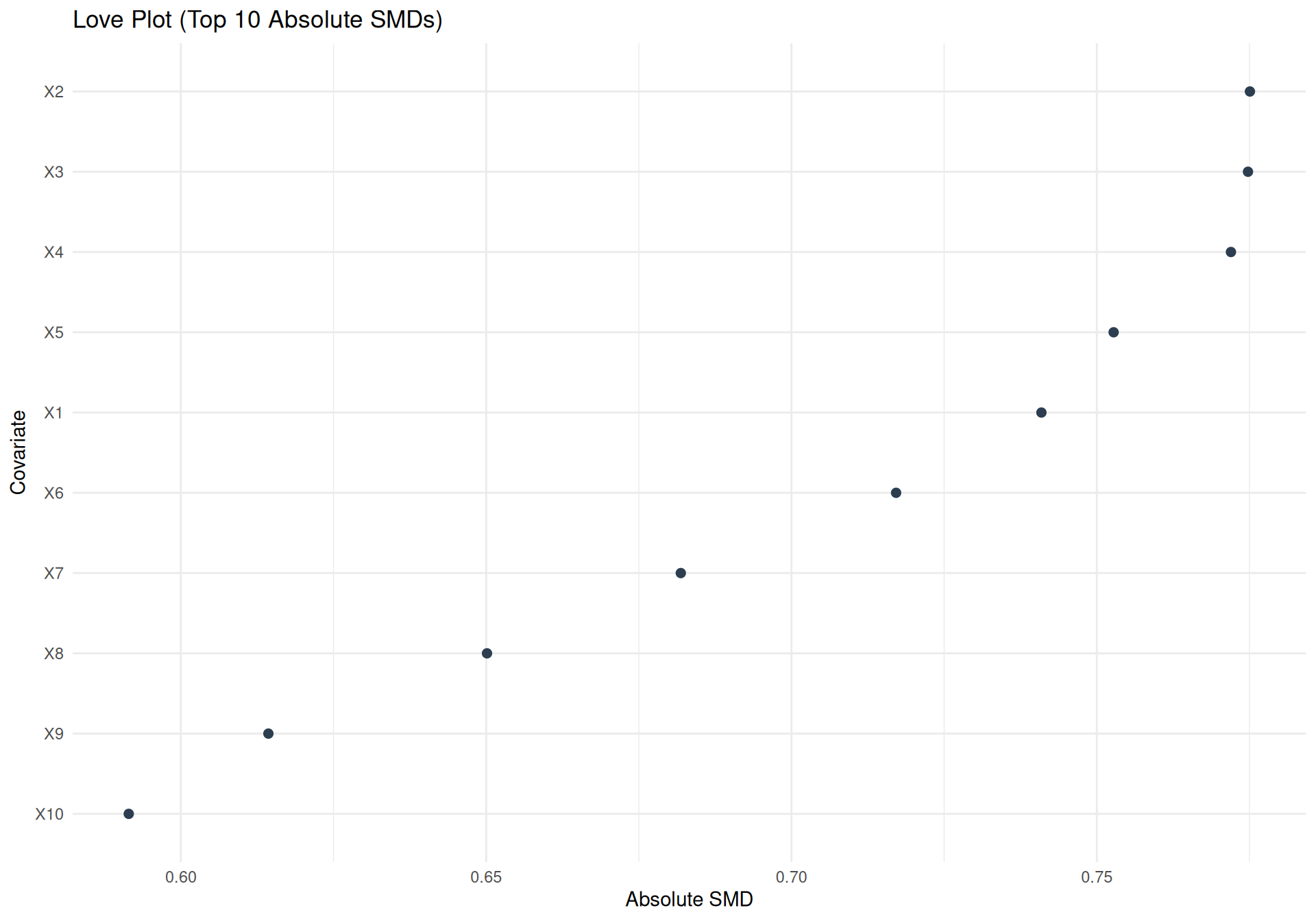
Sparsity and regularization in high dimensions. Tests whether estimators can recover a sparse linear signal without overfitting. Toeplitz correlation ((= 0.95)) increases collinearity and makes nuisance learning fragile, but overlap is restored to be moderate in v1.5.0 so the primary stress is high-dimensional sparsity rather than positivity.
Covariates: [ X ^{100},X (0, ),_{ij} = 0.95^{|i-j|} ]
Outcome (control): [ 0(X) = {j=1}^{5} X_j ]
Propensity: [ (p(X)) = 0.2_{j=1}^{5} X_j ]
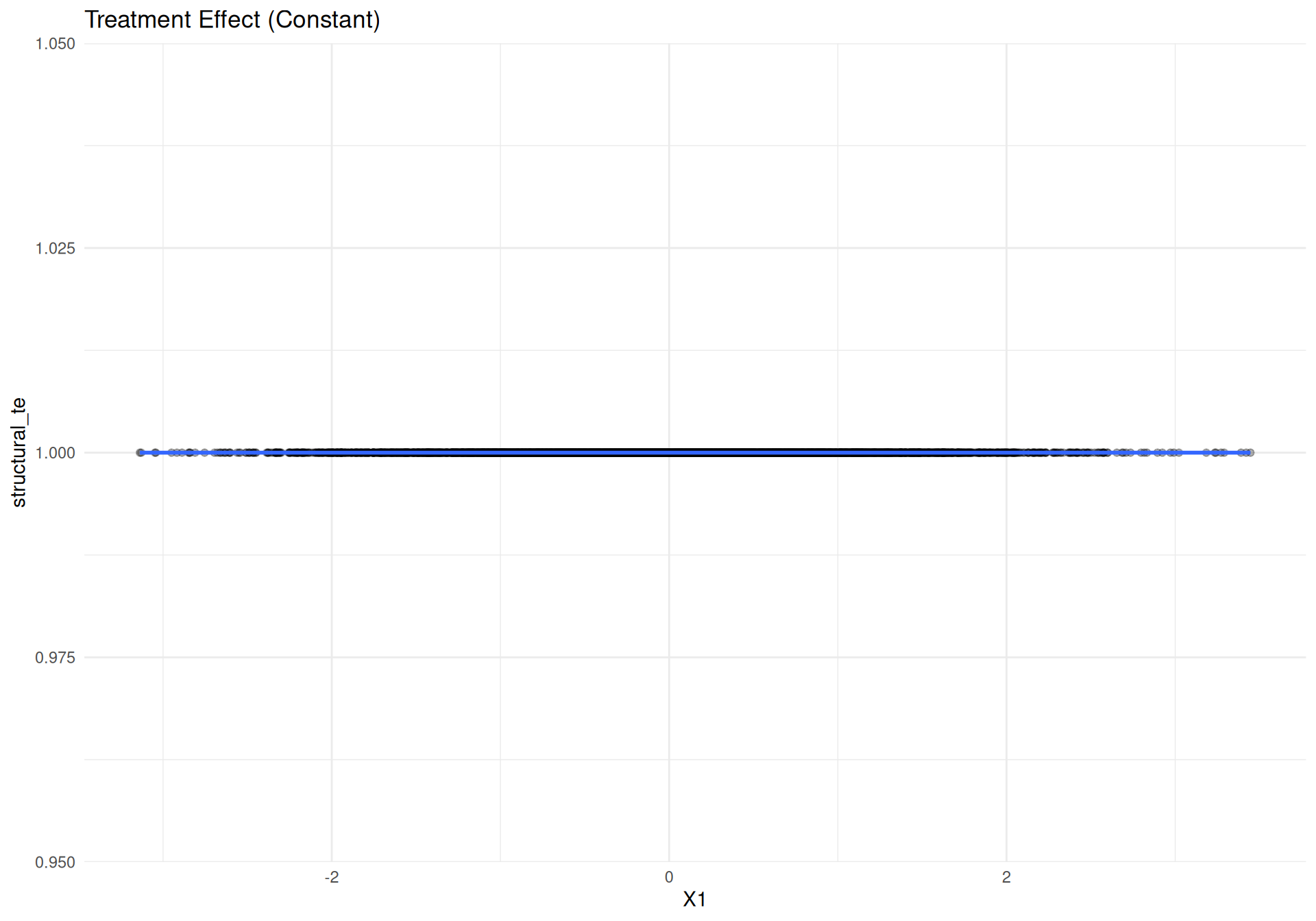
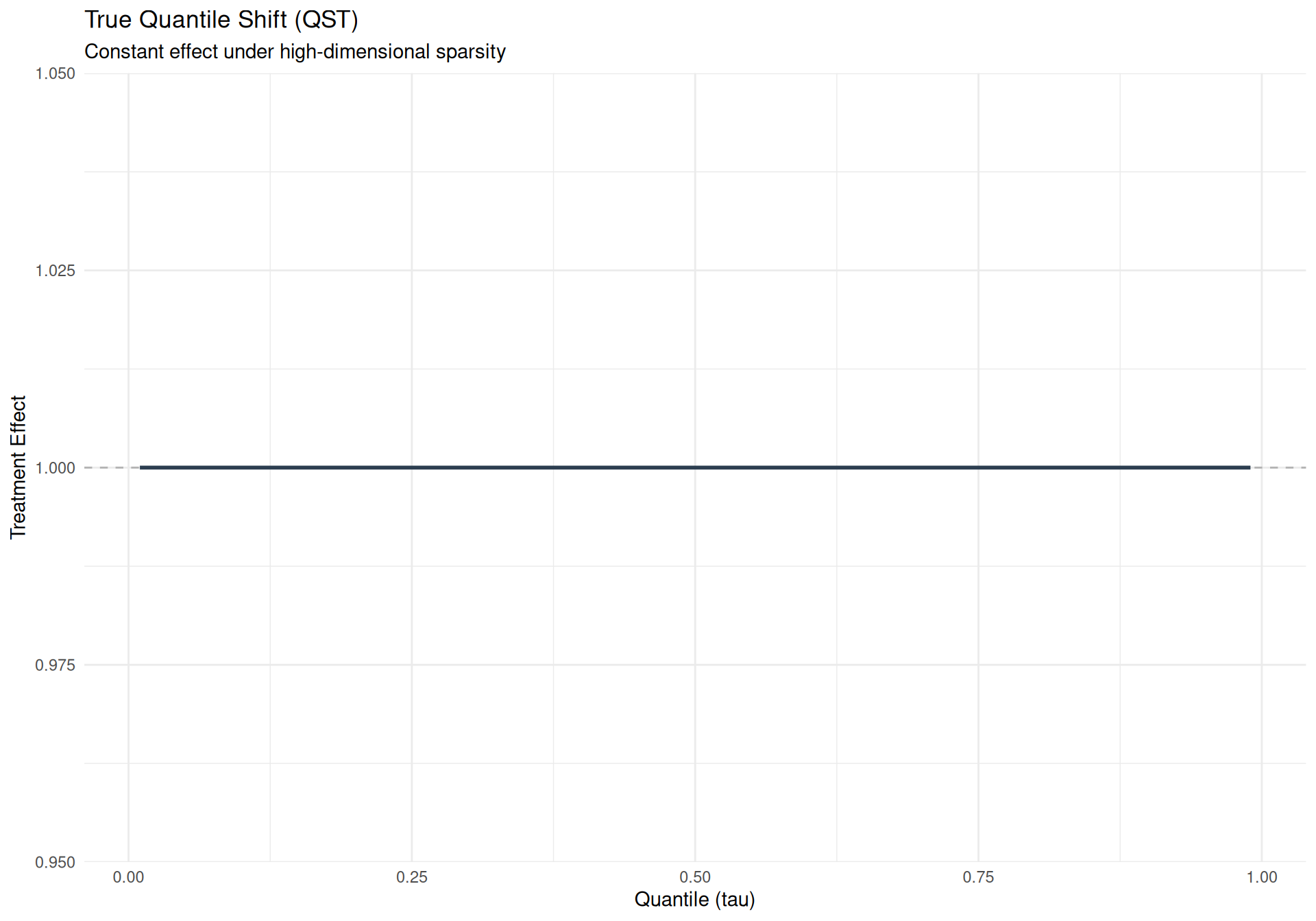
Treatment effect: [ (X) ]
Noise: [ (0, 1^2) ]
structural_te among treated units.cs_get_oracle_qst()).
lm_att serves as the baseline: it matches the sparse linear outcome model.
Victim: ipw_att uses standard (unregularized) logistic regression for the propensity model. In \(P=100\) with \(\rho=0.95\), collinearity and low N/P can still make nuisance estimation fragile, but v1.5.0 restores moderate overlap so the primary stress is high-dimensional sparsity rather than positivity.
| estimator_id | mean_bias | rmse |
|---|---|---|
| ipw_att | -0.166 | 1.105 |
| lm_att | 0.032 | 0.118 |
| oracle_att | 0.000 | 0.000 |
R/dgp-synth-hd-sparse-plm.Rcs_dgp_registry() entry for synth_hd_sparse_plmcs_get_oracle_qst("synth_hd_sparse_plm", version = "1.5.0")Source code for: dgp_synth_hd_sparse_plm_v150
function (n, seed = NULL, include_truth = TRUE, oracle_only = FALSE)
{
if (!is.null(seed)) {
cs_set_rng(seed)
}
p_hd <- 100L
idx <- seq_len(p_hd)
Sigma <- outer(idx, idx, function(i, j) 0.95^abs(i - j))
L <- chol(Sigma)
Z <- matrix(stats::rnorm(n * p_hd), nrow = n)
X <- Z %*% L
colnames(X) <- paste0("X", seq_len(p_hd))
beta_y <- c(rep(1, 5), rep(0, p_hd - 5))
mu0 <- as.numeric(X %*% beta_y)
eps <- stats::rnorm(n, mean = 0, sd = 1)
y0 <- mu0 + eps
tau <- rep(1, n)
y1 <- y0 + tau
gamma <- c(0.2, 0.2, 0.2, 0.2, 0.2, rep(0, p_hd - 5))
lin_ps <- as.numeric(X %*% gamma)
p <- stats::plogis(lin_ps)
w <- stats::rbinom(n, size = 1L, prob = p)
y <- ifelse(w == 1L, y1, y0)
true_att <- cs_true_att(structural_te = tau, w = w)
true_qst <- if (isTRUE(include_truth)) {
cs_get_oracle_qst("synth_hd_sparse_plm", version = "1.5.0")
}
else {
tibble::tibble(tau = cs_tau_oracle, value = rep(NA_real_,
length(cs_tau_oracle)))
}
df <- tibble::tibble(y = y, w = w, y0 = y0, y1 = y1, p = p,
structural_te = tau)
df <- dplyr::bind_cols(df, tibble::as_tibble(X))
out <- list(df = df, true_att = true_att, true_qst = true_qst,
meta = list(dgp_id = "synth_hd_sparse_plm", version = "1.5.0",
type = "synthetic", params = list(n = n, seed = seed),
structural_te = tau))
cs_check_dgp_synthetic(out)
out
}
<bytecode: 0x556365ce5e90>
<environment: namespace:CausalStress>