| DGP ID | synth_baseline |
| Version | 1.6.0 |
| Status | stable |
| Difficulty | ★☆☆☆☆ (1/5) |
| Stress Profile | overlap: moderatenoise: gaussianlinearity: lineareffect: lineartarget: both |
Baseline sanity check: if an estimator fails here, it is fundamentally broken. Intended to confirm correct implementation under ideal linear, well-behaved conditions.
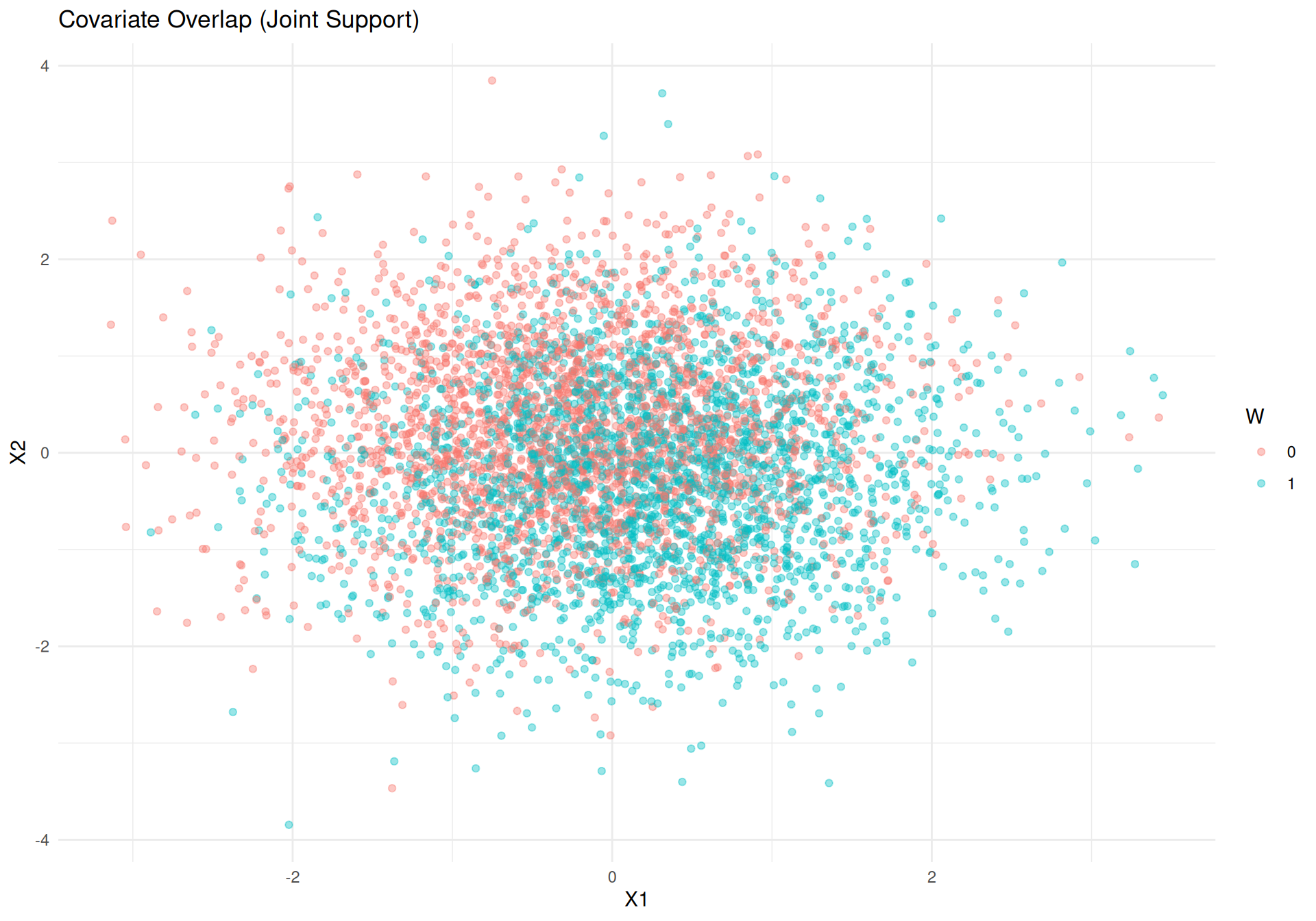
Covariates: \(X_1, X_2, X_3, X_4, X_5 \sim \mathcal{N}(0, 1^2)\) independently. Only \(X_1, X_2\) drive outcomes and treatment.
Outcome (control): \[\mu_0(X) = 1 + X_1 + 0.5 X_2\]
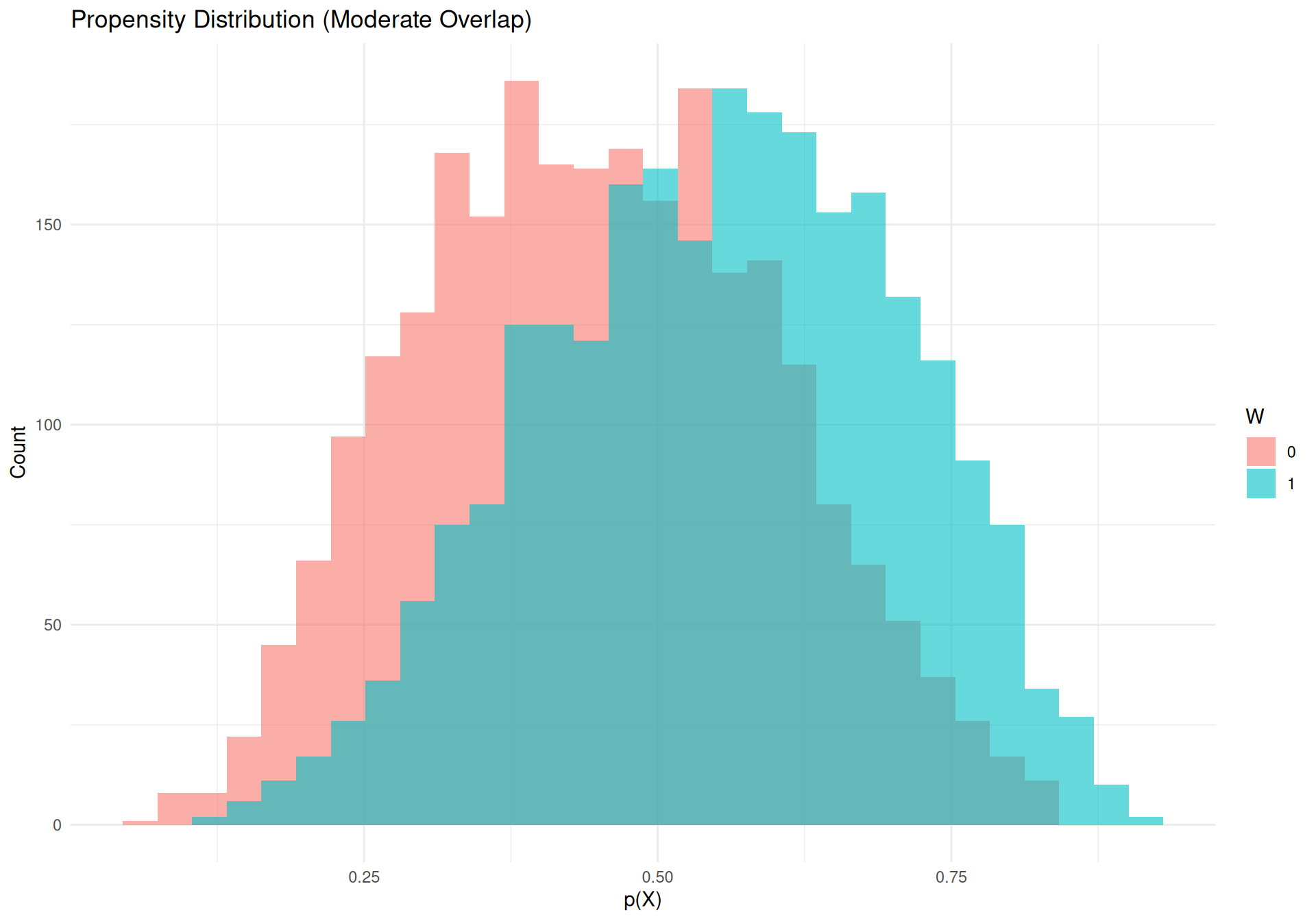
Propensity: \[p(X) = \text{expit}(0.5 X_1 - 0.5 X_2)\]
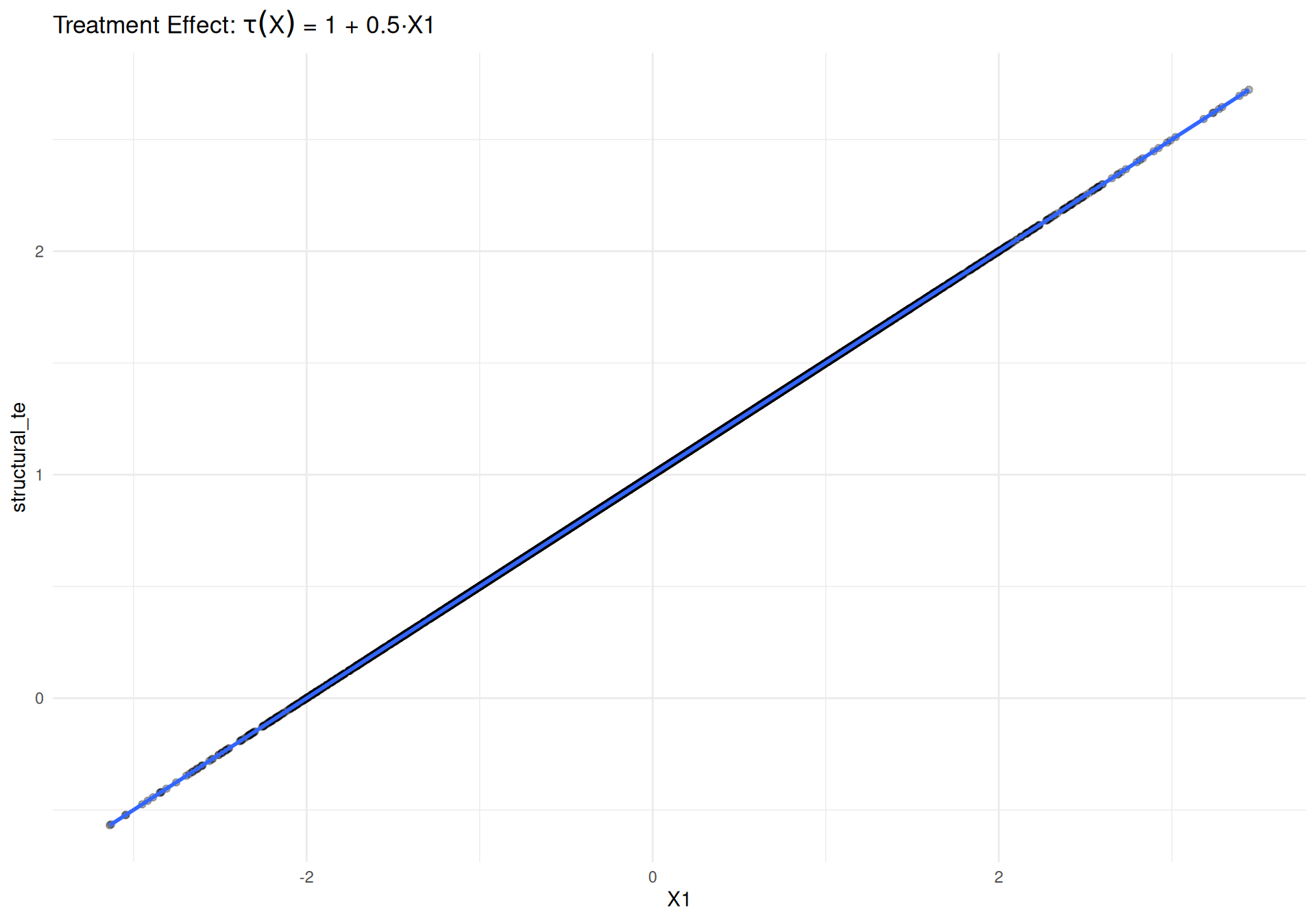
Treatment effect: \[\tau(X) = 1 + 0.5 X_1\]
Potential Outcomes: \[Y_0 = \mu_0(X) + \varepsilon_0\] \[Y_1 = \mu_0(X) + \tau(X) + \varepsilon_1\] where \(\varepsilon_0, \varepsilon_1 \sim \mathcal{N}(0, 0.5^2)\) are independent.
structural_te among treated units.
We expect correctly specified OLS (lm_att) and the oracle to be essentially unbiased on this baseline.
| estimator_id | mean_bias | rmse |
|---|---|---|
| lm_att | 0.002 | 0.012 |
| oracle_att | 0.000 | 0.000 |
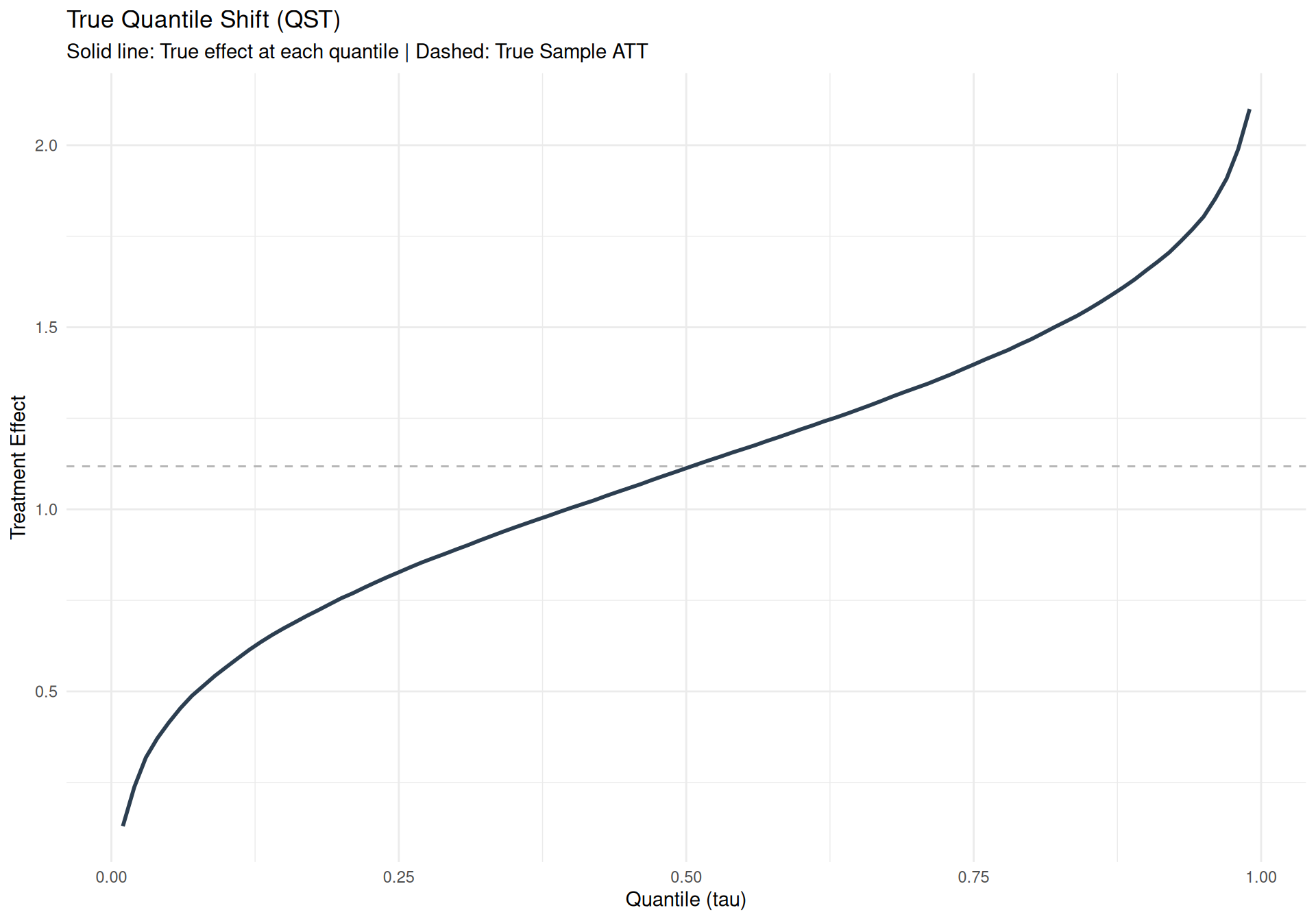
R/dgp-synth-baseline.R (v1.6.0)cs_dgp_registry() entry for synth_baselinetrue_att computed from structural_te among treatedcs_get_oracle_qst("synth_baseline", version = "1.6.0")Source code for: dgp_synth_baseline_v160
function (n, seed = NULL, include_truth = TRUE, oracle_only = FALSE)
{
if (!is.null(seed)) {
cs_set_rng(seed)
}
X1 <- stats::rnorm(n, mean = 0, sd = 1)
X2 <- stats::rnorm(n, mean = 0, sd = 1)
if (!isTRUE(oracle_only)) {
X3 <- stats::rnorm(n, mean = 0, sd = 1)
X4 <- stats::rnorm(n, mean = 0, sd = 1)
X5 <- stats::rnorm(n, mean = 0, sd = 1)
}
mu0 <- 1 + X1 + 0.5 * X2
tau <- 1 + 0.5 * X1
p <- stats::plogis(0.5 * X1 - 0.5 * X2)
w <- stats::rbinom(n, size = 1, prob = p)
eps0 <- stats::rnorm(n, mean = 0, sd = 0.5)
if (isTRUE(oracle_only)) {
eps1 <- eps0
}
else {
eps1 <- stats::rnorm(n, mean = 0, sd = 0.5)
}
y0 <- mu0 + eps0
y1 <- mu0 + tau + eps1
if (isTRUE(oracle_only)) {
return(list(df = tibble::tibble(w = w, y0 = y0, y1 = y1)))
}
y <- ifelse(w == 1, y1, y0)
true_att <- cs_true_att(structural_te = tau, w = w)
true_qst <- if (isTRUE(include_truth))
cs_get_oracle_qst("synth_baseline", version = "1.6.0")
else NULL
list(df = tibble::tibble(y = y, w = w, y0 = y0, y1 = y1,
p = p, structural_te = tau, X1 = X1, X2 = X2, X3 = X3,
X4 = X4, X5 = X5), true_att = true_att, true_qst = true_qst,
meta = list(dgp_id = "synth_baseline", version = "1.6.0",
type = "synthetic", params = list(n = n, seed = seed),
structural_te = tau))
}
<bytecode: 0x5642b9d1dc98>
<environment: namespace:CausalStress>